



Xi Jinping US Visit: Washington में Trump से मुलाकात, Trade, AI और Rare Earths पर नजर
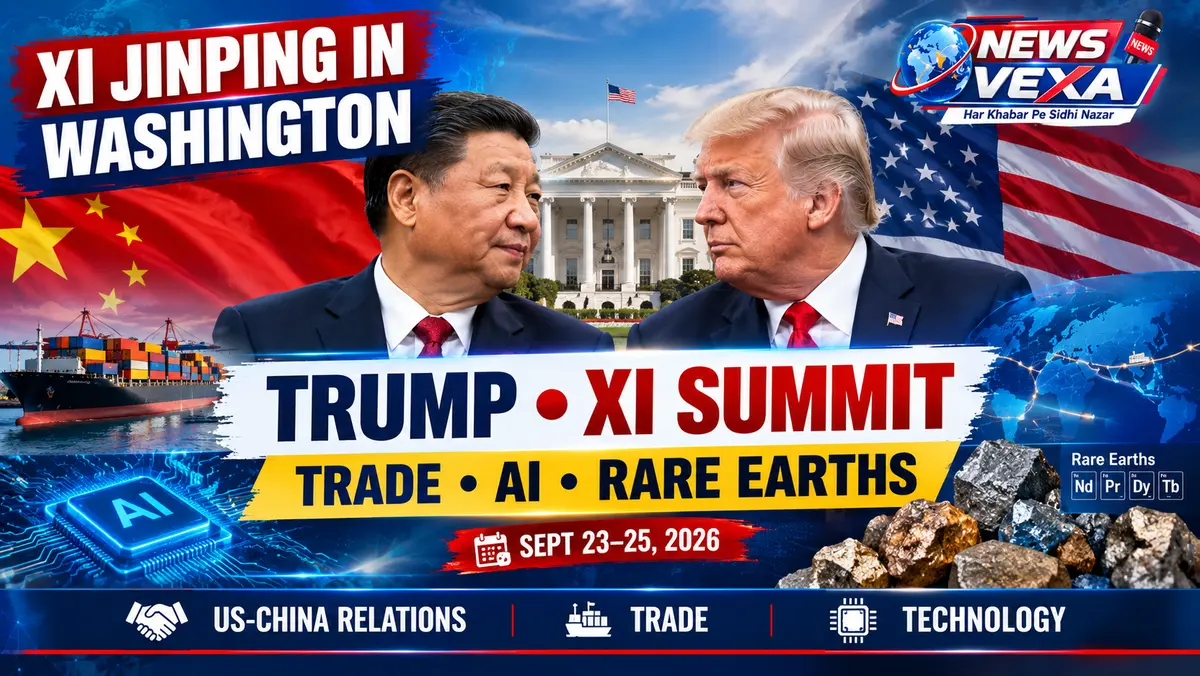
Chinese President Xi Jinping is visiting the United States from September 23 to 25, 2026, at the invitation of U.S. President Donald Trump. The White House says Trump will greet Xi at Joint Base Andrews on September 23, followed by a formal state arrival ceremony and a White House state dinner on September 24.
The most closely watched part of the visit will be the Trump-Xi meeting in Washington, where trade, tariffs, artificial intelligence, rare earths and broader strategic relations are expected to feature prominently. The two sides have maintained dialogue but continue to face disagreements over technology, economic policy and geopolitical issues.
Xi Jinping’s Washington visit: What is confirmed?
China’s Foreign Ministry formally announced that Xi will make a state visit to the United States from September 23 to September 25 at Trump’s invitation. Beijing said the two leaders will exchange views on major issues concerning China-U.S. relations as well as international peace and development.
The White House has also released the schedule for the visit. Trump is due to welcome Xi at Joint Base Andrews on September 23. On September 24, Xi and his wife Peng Liyuan are scheduled to attend a state arrival ceremony at the White House, followed by a state dinner. The visit concludes on September 25 with engagements including a visit to the National Archives.
The trip is particularly notable because it is Xi’s first state visit to Washington since 2015, according to multiple reports.
Trade remains at the heart of the Trump-Xi meeting
Trade is one of the most important issues hanging over the summit.
The United States and China have moved away from the broadest phase of their tariff confrontation, but several trade disputes remain unresolved. Reuters reported that both governments are looking at issues including the possible extension of a tariff truce that is due to expire on November 10.
Ahead of the leaders’ meeting, senior U.S. and Chinese officials have been holding economic discussions in New York. Those talks have included trade, AI, rare earths and other economic issues.
A key question is whether Washington and Beijing can preserve the recent period of relative trade stability while addressing disagreements over market access, technology restrictions and strategic supply chains.
The talks therefore matter not only for the two countries but also for businesses that depend on global manufacturing and technology supply chains.
Rare earths could become a crucial bargaining point
Rare earth minerals have emerged as another important issue in the U.S.-China relationship.
These materials are essential for several advanced manufacturing and technology applications. China has significant influence over global rare-earth supply chains, while U.S. companies have been seeking more predictable access to critical minerals and related products.
Reuters reported that U.S. Treasury Secretary Scott Bessent’s discussions with Chinese Vice Premier He Lifeng ahead of the summit included rare earths alongside AI and trade.
For Washington, reliable access to critical minerals has become part of the broader debate over supply-chain security. For Beijing, export controls and access to strategic materials are among the tools available in its economic relationship with the United States.
AI has moved to the centre of the relationship
Artificial intelligence is another major issue expected to feature in the discussions.
The United States and China are competing heavily in advanced AI, computing and related technologies. At the same time, officials from both countries have been exploring whether they can establish mechanisms for communication around AI-related risks.
Ahead of the summit, U.S. and Chinese officials discussed an AI dialogue and a possible mechanism for notifying each other about certain incidents that could create national-security concerns.
This creates a complicated balance: Washington wants to maintain its technological advantage while Beijing wants continued access to technology and a greater role in the global AI ecosystem.
The negotiations therefore extend beyond ordinary trade policy. They touch the future of advanced technology, semiconductor supply chains and international rules around AI.
Taiwan and Iran add another layer to the talks
The summit is also taking place against a wider geopolitical backdrop.
Taiwan remains a longstanding point of disagreement between Washington and Beijing. Iran is another issue receiving attention because of China’s economic relationship with Tehran and the broader conflict involving the United States.
Reuters identified Taiwan and Iran, alongside trade and AI, among the issues surrounding the leaders’ meeting.
However, the precise outcome of discussions on these sensitive subjects cannot be known in advance. Statements about what either side will ultimately agree to should therefore be treated as expectations rather than confirmed decisions.
Why this meeting matters for the global economy
The United States and China are among the most important economies in the world, and their relationship affects trade flows, technology investment, manufacturing networks and commodity markets.
A prolonged confrontation can increase uncertainty for companies operating across borders. Conversely, greater predictability in tariffs, critical-mineral supplies and technology rules could reduce some of that uncertainty.
But the current relationship is broader than tariffs alone. AI competition, export controls, investment restrictions and geopolitical disputes have become interconnected parts of the relationship.
That is why even limited agreements between Trump and Xi could receive close attention from global businesses and financial markets.
What should India watch in the Trump-Xi talks?
For India, the meeting is relevant particularly because changes in U.S.-China trade relations can affect global supply chains and investment decisions.
The broader China+1 manufacturing strategy has encouraged companies to diversify production beyond China, including toward India and other Asian economies. Analysts have therefore been watching whether a more stable U.S.-China relationship changes corporate supply-chain calculations.
Technology is another area to watch. Any movement on AI, semiconductors or advanced technology restrictions could influence the competitive environment for companies across Asia.
At the same time, India’s own trade, technology and strategic relationships with both Washington and Beijing mean that developments in the U.S.-China relationship can have wider regional consequences.
Key Facts
- Visit: September 23–25, 2026.
- Visitor: Chinese President Xi Jinping.
- Host: U.S. President Donald Trump.
- Main meeting: Trump and Xi are scheduled to meet at the White House on September 24.
- Major economic issues: Trade, tariffs and rare-earth supplies.
- Technology issue: Artificial intelligence and related risks are expected to feature in discussions.
- Broader issues: Taiwan, Iran and the overall direction of U.S.-China relations.
The bigger question is what comes after Washington
The immediate focus is on the Trump-Xi meetings, but the longer-term significance will depend on whether the two governments can translate dialogue into sustained implementation.
Trade commitments, technology rules, rare-earth supplies and communication channels around AI will require follow-up after the leaders leave Washington.
For now, the confirmed fact is that Xi’s state visit has brought the two leaders together for another high-level round of diplomacy. The extent of any concrete agreement will become clearer as the meetings and subsequent official statements unfold.
Sources
China’s Ministry of Foreign Affairs — Xi Jinping to Pay a State Visit to the United States
The White House — Details Ahead of Xi Jinping’s State Visit
Reuters — Factbox: What will Trump and Xi discuss in Washington?
Reuters — U.S. Treasury’s Bessent to discuss AI, rare earths with China’s He
Associated Press — Trump and Xi see tensions flare over AI, trade and Iran but still seek stability