



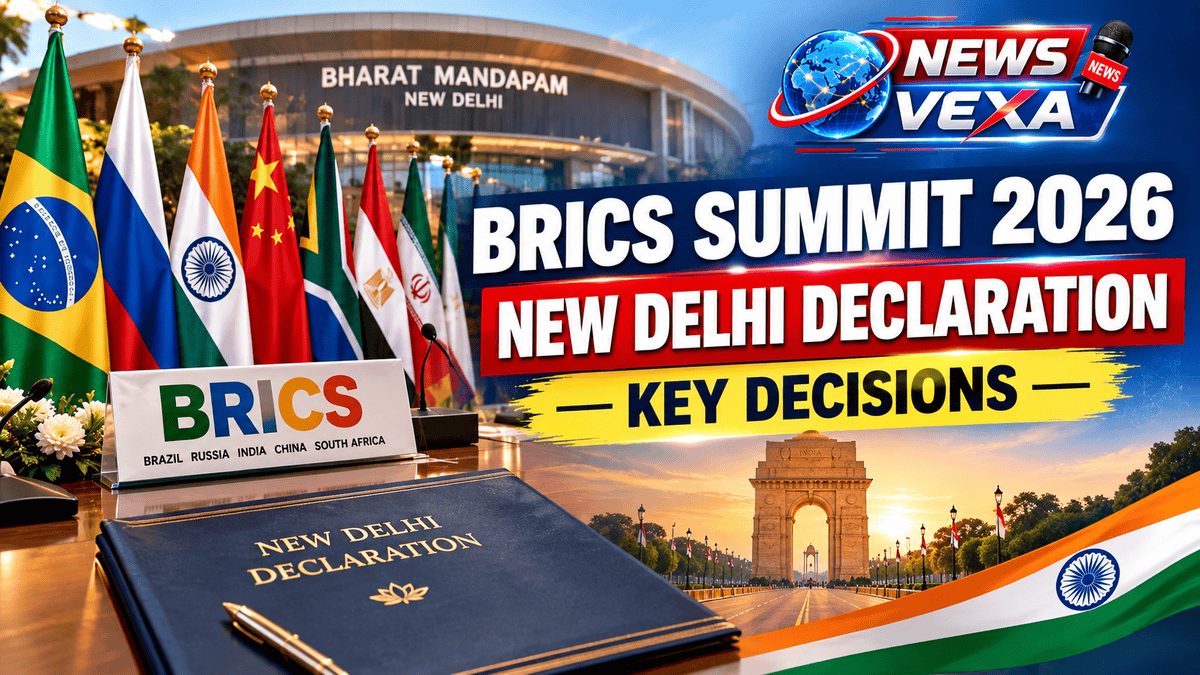
New Delhi: The 18th BRICS Summit, hosted by India in New Delhi on September 12–13, 2026, has concluded with the adoption of the New Delhi Declaration.
The summit brought together the expanded BRICS grouping under India’s 2026 chairship and focused on global governance, terrorism, international peace and security, trade, financial cooperation, technology, artificial intelligence, sustainable development and the priorities of the Global South.
The summit was held under India’s theme of “Building for Resilience, Innovation, Cooperation and Sustainability.” The declaration also welcomed the progress made during India’s BRICS chairship and supported China for the 2027 BRICS chairship.
New Delhi Declaration: What Are the Major Takeaways?
The New Delhi Declaration is the main outcome of the 2026 BRICS Summit. It reaffirmed the bloc’s commitment to multilateralism, international law, greater representation for emerging and developing economies, and a stronger voice for the Global South in global decision-making.
BRICS leaders also reiterated support for reform of major global institutions, including the United Nations, IMF and World Bank, with greater representation for developing countries.
The declaration specifically noted support from China and Russia for the aspirations of Brazil and India to play a greater role in the United Nations, including the UN Security Council.
BRICS Condemns Terrorism and Pahalgam Attack
Terrorism was one of the major issues addressed at the summit.
The New Delhi Declaration strongly condemned terrorism in all its forms and reiterated a zero-tolerance approach. It also specifically condemned the Pahalgam terror attack and called for accountability for those responsible, while rejecting attempts to associate terrorism with any religion, nationality or ethnicity.
The reference to the Pahalgam attack was particularly significant for India because it placed the issue within the formal BRICS declaration.
BRICS Raises Concerns Over Unilateral Tariffs
Trade and protectionism were another major part of the declaration.
BRICS leaders expressed serious concern over rising unilateral tariff and non-tariff measures, saying such measures can distort international trade and undermine the rules-based multilateral trading system.
The bloc reaffirmed support for reform of the World Trade Organization (WTO) and called for a more open, equitable, transparent and predictable global trading system.
No Common BRICS Currency: Focus Shifts to Local Currencies
One important point from the summit is that the focus remains on expanding the use of national currencies for trade and investment, rather than creating a single common BRICS currency.
The declaration supports efforts to facilitate cross-border payments and increase the use of local currencies. BRICS countries are also working on greater interoperability between national payment systems.
This could gradually make cross-border trade between BRICS economies easier while reducing dependence on traditional payment channels.
BRICS AI Cooperation Gets Greater Attention
Artificial intelligence emerged as an important technology issue at the 2026 summit.
The declaration supports cooperation on AI with an emphasis on inclusive, secure and responsible development, particularly considering the needs of emerging markets and developing countries.
China also highlighted new initiatives linked to AI cooperation, including a proposed BRICS AI Open Source Zone.
For India, this is significant because the country has increasingly positioned itself as a major voice in discussions around responsible AI, digital public infrastructure and technology access for the Global South.
India Proposes BRICS Risk Lab at GIFT City
One of the notable India-specific outcomes is the proposal to host a BRICS Risk Lab at GIFT City International Financial Services Centre (IFSC).
The New Delhi Declaration notes India’s proposal for interested BRICS members to participate in the initiative and continue discussions on it.
The proposal gives India’s GIFT City a potential role in deeper financial cooperation among BRICS countries.
BRICS Digital and Health Initiatives
India’s chairship also highlighted cooperation in areas beyond traditional diplomacy and trade.
The summit declaration and related initiatives covered areas including digital public infrastructure, healthcare, industrial development, sustainable development and innovation.
Among the initiatives highlighted during India’s chairship were a proposed BRICS digital public infrastructure repository, a health-focused Training Hub Network with NIMHANS as the lead centre, and the India Centre for BRICS Industrial Competencies.
Modi-Xi Jinping Meeting: Focus on India-China Relations
Prime Minister Narendra Modi met Chinese President Xi Jinping on the sidelines of the BRICS Summit in New Delhi.
The two leaders discussed the broader India-China relationship, including the importance of maintaining peace and stability along the border. They also discussed areas such as trade, business and people-to-people exchanges.
The meeting attracted considerable attention because it came amid continuing efforts by both sides to stabilize bilateral relations.
Modi-Putin Meeting and India-Russia Ties
Prime Minister Narendra Modi also held discussions with Russian President Vladimir Putin during the summit.
India-Russia relations, economic cooperation and broader international developments remained important themes in the engagement between the two leaders. Putin’s participation also highlighted the continued strategic importance of the India-Russia relationship within the BRICS framework.
BRICS and the Global South
A central theme of India’s BRICS presidency was strengthening the voice of the Global South.
The New Delhi Declaration called for greater participation and representation of emerging markets and developing countries in global decision-making institutions.
BRICS leaders also backed reforms aimed at making the global governance system more representative of today’s economic and geopolitical realities.
For India, this fits closely with its broader diplomatic effort to position itself as a bridge between developed economies and emerging and developing nations.
What Does the 2026 BRICS Summit Mean for India?
The summit gave India an opportunity to push several of its priorities within an expanded BRICS framework.
The key areas include:
- Greater representation for developing countries in global institutions
- Stronger cooperation against terrorism
- More use of local currencies in cross-border trade
- Better cross-border payment systems
- Cooperation on AI and emerging technologies
- Greater role for GIFT City in international financial cooperation
- Digital and healthcare cooperation
- Stronger Global South coordination
The adoption of the New Delhi Declaration also gave India a formal document capturing the broad areas of consensus reached during its BRICS chairship.
China to Take Over BRICS Chairship in 2027
India’s BRICS chairship now comes to an end, with China set to take over the chairship in 2027.
The New Delhi Declaration extends full support to China for its BRICS chairship and the holding of the 19th BRICS Summit in China.
China has already indicated plans to deepen BRICS cooperation in areas including AI, trade, finance and technology during its upcoming chairship.
BRICS Summit 2026: Key Takeaways
The 2026 BRICS Summit in New Delhi moved the grouping’s agenda beyond traditional economic cooperation.
The New Delhi Declaration placed major emphasis on multilateralism, Global South representation, terrorism, trade, local currencies, financial cooperation, AI and sustainable development.
For India, the summit also provided an opportunity to advance initiatives linked to GIFT City, digital infrastructure, healthcare and industrial cooperation, while strengthening its diplomatic engagement with major BRICS partners including China and Russia.
The next phase will depend on how effectively the commitments and proposals agreed during the summit are implemented under China’s 2027 BRICS chairship.
Sources
Reuters — BRICS 2026: Additional reporting on China’s BRICS priorities and economic cooperation.
Prime Minister’s Office — BRICS New Delhi Declaration: Official declaration and summit outcomes.
Prime Minister’s Office — Modi-Xi bilateral meeting: Official details of the India-China meeting on the sidelines of the summit.
Indian Express — BRICS Declaration key takeaways: Additional reporting on trade, AI, local currencies and India’s initiatives.